Silicon Valley's Accessibility Theater: How Big Tech Sells the Illusion of Inclusion
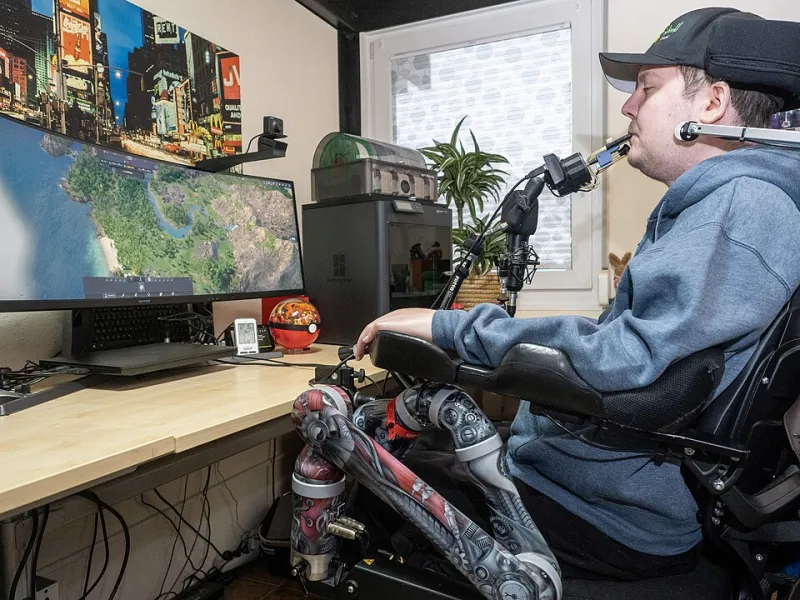
Photo: InclusiveGameLab, CC BY-SA 4.0, via Wikimedia Commons
Every year, like clockwork, a major tech company rolls out a splashy press release about its groundbreaking new commitment to accessibility. There are graphics. There are smiling stock photos of people using assistive technology. There is, inevitably, a quote from a VP of Something-Something Inclusion who has never once sat down with a blind user and watched them try to navigate a checkout flow.
Then, six months later, the screen reader still crashes on iOS 17.3.1, the captioning still mishears every third word, and the "accessible" app still requires seventeen taps to do something a non-disabled user accomplishes in two. But hey — the press release was fire.
Welcome to accessibility theater, America. Grab your popcorn. Or don't — the popcorn button on your smart microwave probably isn't compatible with your switch device anyway.
The Dog-and-Pony Show Starts at the Keynote
Apple, Google, Microsoft — pick your Silicon Valley titan. They all do it. Every major product launch now features at least one segment dedicated to accessibility features, usually delivered with the reverent gravity of someone announcing a cure for a rare disease. "We've added haptic feedback to our notification system," the presenter intones, as if haptic feedback wasn't invented in 2007.
The announcements are real. The features exist. And yet, disabled users across the country will tell you — with the exhausted patience of people who've explained this approximately nine thousand times — that the features are often incomplete, poorly tested, and abandoned within a year when the next shiny thing comes along.
Jared Willis, a blind software developer based in Austin, Texas, put it bluntly in a conversation that could generously be described as a therapy session for both of us: "They'll announce some incredible screen reader update, and I'll get excited, and then I'll try to use it and find out they tested it on exactly one app — their own — and nothing else works. It's like fixing the front door of a house that has no walls."
Jared has filed accessibility bug reports with major platforms that sat open for three years. Three years. For context, in three years, these same companies shipped four new phone models, redesigned their logos twice, and pivoted to AI so hard they gave themselves whiplash.
The Diversity Dashboard Delusion
Here's a fun game: go to any major tech company's corporate responsibility page. Count how many times the word "accessibility" appears. Now try to find a single dedicated accessibility engineer listed on their leadership team. Spoiler: you'll find the Chief Diversity Officer, the VP of Belonging (yes, that's a real title), and seventeen people with "evangelist" in their job description. Accessibility engineers? Buried somewhere between the intern program and the kombucha budget.
The numbers back this up in a depressing way. According to research from WebAIM — a nonprofit that audits web accessibility — over 96% of the top one million website homepages have detectable accessibility failures. Ninety-six percent. These are not mom-and-pop Etsy shops. These are Fortune 500 companies with billion-dollar design budgets who somehow can't figure out how to add alt text to an image.
Maria Chen, a Deaf UX researcher who consults for tech companies she diplomatically refuses to name, described the typical engagement cycle: "They bring me in, I give them a full audit, I tell them exactly what to fix and in what order. They nod a lot. They take notes. Then they implement the one thing that looks good in a press release and ignore the other forty-seven items on the list."
She paused. "At least they always have really nice snacks at their offices."
The Feature Nobody Asked For (But Everyone Got)
One of the great unsung absurdities of corporate accessibility is the phenomenon of the Unsolicited Innovation — the feature that engineers clearly built because it was technically interesting, not because any disabled person requested it or tested it.
Remember when a major platform rolled out an AI feature that would "describe" photos for blind users, and it consistently described birthday cakes as "brown circular objects" and labeled dogs as "possible animal"? Or when a voice control system was updated to recognize commands better — but only in standard American English accents, leaving users with regional accents, speech impediments, or non-native English patterns completely stranded?
These aren't hypotheticals. They're documented, reported, and largely ignored.
"They build for the idea of a disabled person," Willis said. "Some imaginary user who has exactly one disability, no intersecting conditions, speaks perfect broadcaster English, and only ever does the three tasks they thought to test. Real disabled people are inconveniently complicated."
The ADA Lawsuit Pipeline
Here's where things get darkly funny in that particularly American way: the most reliable driver of accessibility improvements at major tech companies isn't internal advocacy, user feedback, or moral decency. It's litigation.
Since the Americans with Disabilities Act has been interpreted to cover digital spaces, lawsuits against inaccessible websites and apps have exploded — jumping from a few hundred per year in 2017 to over four thousand annually by the early 2020s. Companies that ignored years of polite requests from disabled users suddenly discovered the gospel of accessibility the moment a complaint landed on their legal team's desk.
Nothing says "we value inclusion" like being sued into compliance.
The maddening irony is that fixing accessibility issues is, in most cases, neither technically complex nor prohibitively expensive — especially when done from the start of a project rather than bolted on at the end like an afterthought awning. The Web Content Accessibility Guidelines exist. They're free. They're detailed. Developers who specialize in accessible design will tell you that building accessibly from the ground up often makes products better for everyone — clearer navigation, better contrast, more logical structure.
But that would require treating accessibility as a design principle rather than a PR opportunity, and apparently that's a bridge too far.
What Actually Needs to Happen (According to the People Living It)
Every disabled creator, developer, and advocate we spoke to gave variations of the same answer when asked what would actually make a difference: hire us, pay us fairly, and listen to us before the product ships — not after.
Not as consultants brought in for a photo op. Not as focus group participants whose feedback disappears into a Slack channel never to be seen again. As engineers, designers, product managers, and decision-makers who are present from day one and have actual authority over outcomes.
Chen put it simply: "Nothing about us without us isn't a slogan. It's a methodology. The moment you make it optional, it becomes decoration."
So the next time a tech giant announces its revolutionary new commitment to accessibility — complete with an inspirational video set to piano music — maybe hold the applause until you've checked whether their own website passes a basic screen reader test.
Spoiler: it probably doesn't.
But the press release? Chef's kiss. Totally accessible PDF format. Probably.